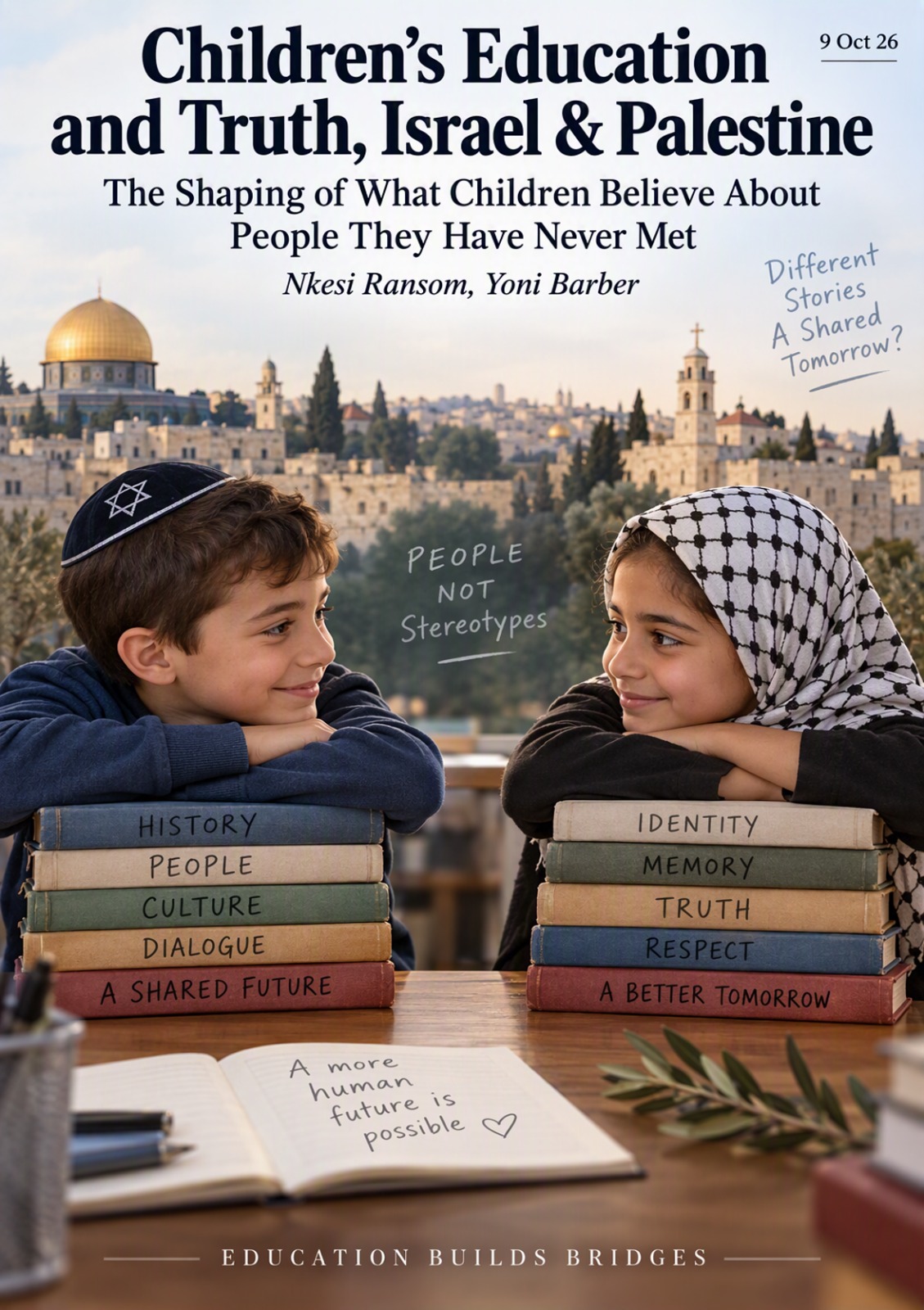
The Shaping of What Children Believe About People They Have Never Met
Nkesi Ransom, Yoni Barber
A child can inherit an image of someone they have never met. Before a child understands history, they may already develop a sense of who belongs in their society and who does not, who is trusted, who is feared, and whose story matters. That education comes not only from textbooks, but from teachers, parents, religious lessons, media, family memory, national narratives, and silence. The decisive question is: WHAT HAPPENS TO THOSE CHILDREN WHEN THEY ARE WRONGLY TAUGHT ABOUT PEOPLE, BEFORE THEY EVER HAVE THE OPPORTUNITY TO MEET THEM?
WHO ARE WE—AND WHO ARE WE NOT? Every society teaches identity. But the “other” can enter education through absence, stereotype, enemy imagery, inherited trauma, and selective memory. The danger begins when remembering our own suffering requires forgetting another person’s humanity. The challenge is therefore not only teaching children what happened but teaching them how to encounter people whose history tells the same story differently.
ONE HISTORY. DIFFERENT MEMORIES. The Middle East carries competing memories of persecution, displacement, independence, war and survival. 1948, for example, is remembered by many Jews and Israelis in connection with the establishment of the state of Israel at the cost of thousands of Jewish lives after the fledgling state was attacked by 5 enemy states. Meanwhile, Palestinians remember the same period as “the Nakba”, associated with displacement and loss, matched by concurrent forced displacement of Jews from Arab lands. Education should neither erase painful memory nor pretend every claim has equal validity. It should teach children truth, to discern between fact, interpretation, narrative and political claim, and to ask difficult questions without fear. So how does this apply in the Middle East, in particular with the competing claims of Israel and the Palestinian movement?
JEWISH EDUCATION, PALESTINIAN EDUCATION. A 2016 peer-reviewed comparative study by Sami Adwan (Arab) of Bethlehem University, Daniel Bar-Tal (Jewish) of Tel Aviv University and Bruce Wexler of Yale found that both Israeli and Palestinian textbooks tend to present a unilateral national narrative. However, they found that the negative portrayal of the other and absence of information about the other were significantly more pronounced in Palestinian and Jewish ultra-Orthodox (14.3% of the population) books than in Israeli state books. Similarly, Samira Alayan’s (Arab) peer-reviewed study found that the Holocaust was absent from the Palestinian Authority textbooks she examined.
The Israeli state, overall, increasingly provides considerably more room for competing narratives, self-criticism and discussion of Palestinian suffering than the Palestinian Authority (PA) curriculum provides for the Israeli/Jewish narrative.
By contrast, the current PA curriculum contains examples going beyond nationalist bias into political indoctrination, glorification of violence and the presentation of Israelis primarily through the framework of occupation and conflict.
| Jewish Israeli state education | Palestinian Authority education | |
| Strong national narrative | Yes | Yes |
| Teaches own historical suffering | Very strongly | Very strongly |
| Teaches suffering of the other | Increasingly | To a much lesser extent |
| Self-criticism | Significant | Much less developed |
| Teaches the other side’s narrative | Yes, although unevenly | Limited |
| Presents peace as desirable | Strongly | Mixed/weak |
| Presents Israel as legitimate | Yes | Generally, not |
| Presents Palestinians as a legitimate people | Increasingly yes | Yes |
| Glorification of individuals who killed civilians | No in mainstream state curriculum | Yes, documented examples |
| Political material in maths/science | Not a defining feature | Documented extensively |
| Alternative interpretations encouraged | Considerably | Much less |
DIFFICULT HISTORY WITHOUT HATRED. Children do need to gradually learn about persecution, terrorism, antisemitism, racism, and persecution. But perceptions of people must not be reduced to governments, armies, movements, religions or stereotypes. This is the problem of the PA education system’s narrative, which is demonstrably reinforcing generational hatred. A government is not an entire people. A political movement is not an entire faith. Individual wrongdoing does not create inherited guilt. Children can gain a nuanced understanding of injustice based on truth.
CONVICTION DOES NOT REQUIRE CONTEMPT WHEN THE “ENEMY” BECOMES HUMAN. A diary, photograph, letter, testimony or child’s drawing can give history a face. Truth about the other rather than indoctrination based on untruth releases the possibility of relationship. The “other” becomes a mother, father, child, neighbour, colleague, rather than an entity to be feared. Humanizing another person does not require agreeing with them; it requires recognizing their humanity.
THE NEW CLASSROOM IS EVERYWHERE. The smartphone has become another classroom. Children, as well as adults, encounter political claims, graphic images, propaganda and viral narratives without necessarily asking, “Is this true?” Media literacy is therefore essential: Who produced this? What evidence exists? What context is missing? Is it journalism, opinion, propaganda, satire or interpretation? What emotion is the message trying to create? Truth does not fear investigation. Without teaching children the tools to seek out and assess truth while recognising deception, social media generates the same polarizing environment of toxic indoctrination as the PA classroom. As such it becomes the primary channel for globalising antisemitic hatred.
EDUCATION AS A BRIDGE. Bilingual education, student exchange, joint research and carefully moderated dialogue can transform an abstract population into real people. The educational isolation of Israel through the Boycott, Divestment and Sanction movement must be combatted. A Jewish child should not have to abandon their identity to understand Palestinian suffering, whatever the cause of that suffering might be. Similarly, a Palestinian child should not have to abandon their background to understand Jewish historical trauma. Human dignity is unconditional.
THE REAL TEST OF EDUCATION. The goal is not forced agreement. It is truth without hatred, identity without superiority, memory without dehumanization, and conviction without contempt. Every child will eventually meet someone they were taught to understand from a distance. The stereotype will gain a face. The political category will become a colleague. The “enemy” will have a name. The deepest purpose of education is not merely to teach children what happened. It is to teach them how to pursue the truth about what happened, and how to remain human while doing so.
Wherever we live, one day every child will encounter “the other.” The final examination will not be in a textbook. IT WILL BE HOW THE CHILD RESPONDS TO THE HUMAN BEING STANDING BEFORE THEM.
References:
Adwan, Sami, Daniel Bar-Tal, and Bruce E. Wexler. (2016). ‘Portrayal of the Other in Palestinian and Israeli Schoolbooks: A Comparative Study.’ Political Psychology, 37(2), 201–217. DOI: 10.1111/pops.12227.
Alayan, Samira. (2016). ‘The Holocaust in Palestinian Textbooks: Differences and Similarities in Israel and Palestine.’ Comparative Education Review, 60(1), 80–104.
DOI: 10.1086/684362.
Leave a Reply